


Click-through rate (CTR) is a metric that measures how often people click on a link out of the total impressions (views) that the link receives. In the context of SEO, CTR usually refers to the percentage of searchers who click on a website’s listing in the search engine results page (SERP) for a given query.

For example, if 1000 people see your Google search snippet and 200 of them click through to your site, your organic CTR for that query is 20%. A high CTR means a lot of searchers found your title and description compelling enough to click, indicating your snippet matches their intent.
CTR is an important performance indicator for SEO because it bridges visibility and engagement. Ranking high on Google is valuable, but the ultimate goal is to attract relevant organic traffic. If your page ranks well but nobody clicks it, you won’t gain visitors. By tracking organic CTR, website owners can gauge how effective their titles and descriptions are at attracting clicks from search results. As former Google engineer Matt Cutts put it, “You want to think about rankings and then you want to think about maximising your click-through…”. In essence, CTR shows how appealing your search listing is to users and how well it converts impressions into visits.
Does CTR Influence SEO Rankings?
There is an ongoing debate in the SEO community about whether Google uses CTR as a ranking signal. Historically, some SEO experts have believed that higher organic CTR can boost a page’s rankings, treating CTR as part of Google’s ranking algorithm (the idea being that if users click one result more than others, Google might rank it higher).
Notably, a famous 2014 experiment by Rand Fishkin saw a crowd of users search a specific term and click his blog post; that page shot to the #1 position in Google within hours. This fueled speculation that query CTR could directly influence rankings, at least in the short term.
However, Google’s official stance has been consistent: CTR is not a direct ranking factor in their algorithms. Google representatives like Gary Illyes and John Mueller have repeatedly stated that user click data is “too noisy” and easily manipulated to be a reliable signal for broad rankings. In fact, Google uses click metrics primarily in controlled situations, such as internal quality testing or personalising results for individual users, rather than as a core part of the ranking algorithm for everyone. Mueller specifically confirmed that having lots of people (or bots) click your site in search results “does not hurt or help” your rankings. The consensus from Google is that while CTR might correlate with relevance, it’s not a reliably weighted factor for SEO rankings because it can be gamed.
Why, then, do people care about CTR for SEO? First, a high organic CTR naturally means more traffic, even if your ranking position stays the same, so improving CTR through better titles and snippets is just good practice for maximising traffic. Second, there is a lingering belief (despite Google’s denials) that in certain scenarios, CTR and other user behaviour signals might influence rankings indirectly. For example, Google’s RankBrain and other machine-learning systems might interpret unusually high click-throughs as a sign of content relevance for trending or ambiguous queries, potentially giving a temporary rankings boost. This grey area has led some SEO practitioners to attempt CTR manipulation as a tactic to influence rankings, even if it’s not officially supported by Google.
What is CTR Manipulation?
CTR manipulation refers to artificially inflating the click-through rate of a webpage’s search listing – essentially, trying to trick search engines into thinking your page is more popular or relevant than it truly is. It’s considered a black-hat SEO technique because it involves deceitful practices (bots or fake clicks) rather than genuine organic improvements.
With CTR manipulation, the goal is to generate fake or orchestrated clicks on your search result snippet. Typically, an automated program or a network of people will search for a target keyword, find your site in the results, and click on it, not out of real interest, but purely to boost the page’s CTR metric. This surge in clicks (relative to impressions) may send positive signals to Google’s ranking systems, potentially resulting in a higher ranking for that keyword, at least temporarily.
CTR manipulation essentially falls under the umbrella of click fraud or engagement manipulation, which violates the policies of Google and other search engines. Google’s guidelines explicitly discourage any kind of artificial traffic or automated queries to influence search results. In fact, sending automated search queries or fake traffic is against Google’s spam policies and Terms of Service. If caught engaging in such practices, a site can be disciplined or penalised for attempting to game the system. This could include ranking demotions or even removal from search listings in severe cases, as we’ll discuss later.
It’s important to distinguish CTR manipulation from legitimate CTR optimisation. Improving your organic CTR the right way – by writing compelling meta titles and descriptions, using structured data (rich snippets), and aligning content with search intent – is an ethical SEO strategy.
Some people might casually refer to this as “manipulating CTR,” but it’s simply making your result more attractive to real users. In contrast, “CTR manipulation” in the context of this article refers to deceptive tactics like bots and click farms that generate clicks with no genuine user intent. In short, if you’re intentionally faking clicks on search results, that crosses into manipulation territory (and likely breach of search engine guidelines).
How Does CTR Manipulation Work?
CTR manipulation schemes typically follow a straightforward playbook: artificially generate searches and clicks for targeted keywords to inflate the target page’s click-through rate. Here’s how it commonly works:
- Target Keyword Identification: The SEO or marketer picks specific keywords where they want to improve a page’s ranking. Often, these are keywords where the page is on page 2 or the bottom of page 1 of Google – the idea is to push it higher by making its listing seem very popular (high CTR) relative to competitors.
- Automated Searches and Clicks: Using software bots or arranged human workers, the system performs a Google search for the target keyword. It then programmatically scans the search results until it finds the target page’s listing and clicks on it. This mimics a real user choosing that result. The process may be repeated thousands of times across different IP addresses or devices to accumulate a large number of fake clicks.
- Simulating “Normal” User Behaviour: Advanced CTR manipulation tools try to imitate human browsing patterns after the click. For example, the bot might stay on the site for a configurable amount of time (e.g. 60–120 seconds) and even scroll or click around on internal pages. This is done to send engagement signals like lower bounce rate, longer dwell time, and multiple page views – so that Google sees not just a click, but a “happy” user who didn’t immediately pogo-stick back to search results. Some services let you set the number of pages to visit (say 3–5 pages per session) and the duration on site to mimic real users browsing.
- Geographic and Device Diversity: To avoid obvious patterns, CTR manipulators may use proxies or VPNs to vary the IP location of clicks (e.g. simulating searches from different cities or countries). They also attempt to randomise user agents (desktop, mobile, various browsers) so that the clicks come from a mix of devices, appearing more organic. Sophisticated tools even integrate with Google Suggest by typing the keywords character-by-character in the search bar (to mimic normal user typing behaviour).
- Crowdsourcing Real People: An alternative method uses crowd workers instead of bots. Through platforms like Amazon Mechanical Turk, Microworkers, or dedicated “crowd click” services, marketers pay human users to perform the search and click tasks. The idea is that humans with unique devices and IPs will appear more genuine and harder for Google to detect than automated botnets. (Services like SerpClix, for example, recruit real people around the world to click on clients’ search results for a fee.) However, even with crowdsourcing, these are coordinated, incentive-driven clicks, not authentic search behaviour.
- Continuous/Repeat Process: Often, CTR manipulation isn’t a one-time stunt; it may be done continuously or in bursts over days/weeks to sustain an elevated CTR. Some campaigns might deliver dozens or hundreds of fake clicks per day for each target keyword, especially in competitive niches. The hope is that over time, this higher-than-normal CTR convinces Google’s ranking algorithms that the page is highly relevant, thus improving its rank position and visibility.
In summary, CTR manipulation works by creating an illusion of popularity. It leverages the assumption that if “many users click this result”, it must be the best result, and tries to exploit that. The tactics range from straightforward bots to complex human simulations, but the core concept is the same: send lots of fake organic traffic to a URL from search results to boost its performance metrics.
Common CTR Manipulation Strategies
Implementations of CTR manipulation can vary. Here are some of the common strategies and tactics used to boost click-through rate artificially:
1. Automated Bot Traffic
This is the most direct method. Specialised software (often called CTR bots) automates the entire process of searching and clicking. Tools like SearchSEO.io’s CTR bot or Viper Tools allow users to input keywords and target URLs, then use headless browsers or scripted browsers to perform searches on Google and click the results. These bots often run through lists of proxy servers or cloud servers to generate hits from different IPs.
Bot traffic is cheap and scalable – thousands of clicks can be generated quickly. However, if not done carefully, it’s also easier for Google to detect patterns (e.g., all clicks coming from a limited set of user agents or lacking the typical variance of human behaviour). Basic bots might not scroll or behave like real users, making their clicks stand out as low-quality or fake.
2. Micro-Task Crowdsourcing
To add a layer of human realism, some SEO practitioners turn to crowdsourcing platforms. They create micro-tasks instructing users: “Search [keyword] on Google, click the result for [site], stay on the page for X seconds.” By paying a small fee per task, they can recruit hundreds of people globally to perform these clicks. Platforms such as Microworkers and Mechanical Turk have been used for this purpose.
There are also SEO-specific services like SerpClix and CrowdSearch that maintain networks of real people who get paid to do organised searching and clicking. The advantage here is that each click comes from a real human with a unique device and IP, potentially even with a Google account, making it harder for Google to algorithmically filter out.
The downside is cost and coordination – paying humans is more expensive than running bots, and the scale is limited by participant availability. Moreover, Google can still detect patterns if all those users belong to known networks or exhibit synchronised behaviour; SEO case studies note that clicks from large known networks (like obvious click farm IP ranges) might yield only short-lived boosts before Google negates their effect.
3. Click Farms and Fake User Networks
A more illicit variant of crowdsourcing is the use of click farms – operations (often in low-wage countries) where workers or an array of devices are set up to generate clicks en masse. These can blur the line between bots and humans (e.g., one person running scripts on hundreds of phones).
They promise high volumes of “real” clicks. This strategy carries similar risks: if the click farm’s traffic patterns are recognised (e.g., dozens of searches from the same subnet or devices with no variation), Google may discount them. Many third-party CTR manipulation services essentially operate their own private click networks or farms.
4. Behavioural Signal Simulation
Beyond just clicking the result, advanced tactics focus on simulating quality user behaviour. This means ensuring that the artificial clicks do not immediately bounce back to Google. Techniques include having the bot or crowd user spend time on the page, scroll down, click an internal link, or even play a video – anything to resemble a satisfied user session.
Some manipulation tools allow configuration of dwell time (time on site) and page views per visit, as seen with SearchSEO’s settings (1–5 minutes on site, visiting 2–5 pages per session). The purpose is to influence secondary signals like bounce rate, session duration, and pogo-sticking.
Google’s algorithms are believed to interpret quick bounces (users returning to search instantly) as negative feedback on result quality. By preventing immediate bounces in the fake clicks, manipulators attempt to cover their tracks and reinforce the illusion that these clicks are from genuinely engaged users.
5. Organic CTA Manipulation
This is a borderline strategy – rather than using fake users, some SEOs will try to leverage real user bases to affect CTR. For instance, an email blast or social media post might encourage a brand’s loyal audience to “search for our on Google and click our site.” Or a YouTuber might instruct followers to Google a certain phrase. This can result in a spike of authentic searches and clicks from interested users, which is less artificial.
It’s a bit of a gray area ethically (you are coaching users to behave in a way to influence rankings), but since the users do have genuine interest, it’s not as blatantly fake as bots or paid click-farm users. Still, Google likely discounts unusual one-time spikes, and this strategy isn’t scalable or sustainable long-term.
Each of these strategies shares the same goal: boost organic CTR metrics by any means possible. Some practitioners combine methods (e.g., running bots to supplement human click tasks) to maximize impact. It’s worth noting that all these fall outside Google’s recommended practices – they are attempts to manipulate the “behavioral” aspect of SEO rather than improving the actual content or relevance of a page.
Tools and Services for CTR Manipulation (Including SearchSEO)

Over the past few years, a cottage industry of CTR manipulation tools and services has emerged. These range from self-service software to full-fledged managed services. Here are a few notable ones:
- SearchSEO.io CTR Bot: SearchSEO is a widely mentioned tool specifically designed for CTR manipulation. It’s a software-as-a-service that allows users to run organic click campaigns. You input keywords and target URLs, and the SearchSEO bot will search those terms on Google, scroll through the SERPs to find your listing, then click it and visit your site. Under the hood, it uses a network of browsers or devices to try to appear as real users. One of SearchSEO’s selling points is customization – it supports geo-targeting (searching from over 150 countries to mimic local search traffic) and offers a dashboard to track your keyword rankings and the clicks delivered. It also allows configuring user-like behavior, such as how many internal pages to click and how long to stay on the site during each visit. Essentially, SearchSEO is marketed as a traffic bot for organic SEO growth, aiming to send “realistic” signals to Google. Its pricing plans range from small packages (25 searches per day for ~$29/month) up to large agency packages (hundreds of searches per day). While SearchSEO makes bold claims about raising rankings with CTR manipulation, independent reviews have noted that it may be detectable by Google due to insufficient diversity in its simulated users. In fact, after extensive testing, some SEO reviewers reported no significant ranking improvement using SearchSEO, suggesting that Google filtered out its effects.
- SerpClix: Unlike bot-based tools, SerpClix operates a crowdsourced click network. It has a large pool of real human “clickers” who have a browser extension installed. When you run a campaign, those users are prompted to perform your target search and click your result. Because actual people are performing the action on their own computers (with presumably varied IPs and normal browsing profiles), the clicks appear organic. SerpClix charges per click, with pricing based on the number of clicks and geographic targeting you need. This service highlights the use of real human engagement as a safer form of CTR boosting – though as noted, Google can still catch patterns especially if the same users keep clicking or if the behavior looks orchestrated.
- CTR Booster and Other Software: CTR Booster is a desktop software (Windows-based) that allows you to run your own botnet of click bots. Users can set up residential proxies and configure CTR Booster to send traffic from those proxies, giving more control over the process. It requires some technical setup (proxies, servers, etc.), but appeals to those who want to self-manage and not rely on a third-party cloud service. Similarly, there are tools like Pogoz (Pogo sticking bots) and scripts shared in black-hat SEO forums for those who want DIY solutions.
- Viper Tools: Mentioned in some SEO communities, Viper is another tool that claims to use real user machines combined with headless browsers to conduct searches and clicks. The idea is to harness a distributed network that appears as unique users. Some SEOs prefer such tools, claiming they have a lower footprint (less detectable) than simpler bots. Viper might function on a credit or subscription model as well.
- Managed CTR Manipulation Services: Apart from DIY tools, there are agencies or freelancers who offer CTR manipulation as a service. They might combine various methods (bots + mechanical turk + their own secret sauce of traffic) to deliver a promised CTR increase. For example, certain SEO agencies quietly include “behavioral signals improvement” in their offerings – essentially, they’ll run CTR campaigns on your behalf. While these providers often keep their methods opaque, hiring a service doesn’t shield you from the risks if Google catches on.
It’s crucial to remember that using these tools is risky. They exist because there’s demand from webmasters eager for any ranking edge. Services like SearchSEO and SerpClix advertise themselves as “safe” ways to increase organic CTR and boost rankings. But as we’ll explore, the effectiveness of these tools is questionable, and their use violates search engine guidelines. Even some tool providers themselves acknowledge mixed results – for instance, an SEO review of SearchSEO noted “after lots of testing, we did not manage to see the benefits we thought we would get” and suggested looking at other solutions or focusing on other SEO factors instead.
Potential Benefits of CTR Manipulation
Why do marketers even consider CTR manipulation, given its sketchy reputation? The appeal lies in a few potential short-term benefits:
- Quick Ranking Boosts: Anecdotal evidence and small experiments have shown that aggressive CTR manipulation can sometimes lead to immediate jumps in rankings. For example, in one case study a site that was stuck on page 4 of Google (around rank 34) moved up to the top 10 results within 22 days after a CTR manipulation campaign began. Over a span of about three weeks – with no other changes made – the page climbed onto page 1, allegedly due to the influx of clicks on its result. The ranking even continued to improve, peaking at #3 before stabilizing on page 1 for months. In another experiment on a new website, about 93 artificial clicks over two weeks helped its main keyword jump significantly in position. These instances suggest that when done cleverly (especially using real or high-quality simulated users), CTR manipulation might trigger Google to temporarily rank a page higher, interpreting the high click-through as a sign of relevance. For an SEO struggling to get a page to break into the top results, this kind of rapid improvement is very enticing.
- Increased Organic Traffic: If the manipulated rankings hold even for a short time, the site can enjoy a surge of organic traffic. More visibility at the top of the SERPs means more real users clicking. In essence, CTR manipulation can create a positive feedback loop where fake clicks boost the ranking, which then leads to genuine clicks from actual searchers. Those real visits could result in conversions or other benefits. Some proponents argue that even if the ranking gains are temporary, the extra traffic (and possibly the user behavior data from that traffic) can help a site gain exposure or collect leads it otherwise wouldn’t have.
- Edge in Competitive Niches: In ultra-competitive SEO niches (like insurance, loans, etc.), every ranking factor advantage matters. Some black-hat SEOs consider CTR manipulation as a way to gain an edge over competitors. If all top competitors are closely matched on traditional factors (content, links, etc.), one might attempt to artificially boost their CTR to stand out. Even if Google doesn’t use CTR as a core factor, there’s a belief that high engagement metrics might indirectly support better rankings. For instance, a high CTR might lead to more traffic and potentially more natural backlinks or user signals down the line. It’s a bit speculative, but the mindset is to exploit any possible factor.
- Influencing User Behavior Metrics: By orchestrating clicks and on-site engagement, CTR manipulation can beautify your analytics metrics – lower bounce rates, higher time-on-site, more page views. If you’re presenting results to clients or stakeholders, these improved metrics might make it look like the site’s user experience is better (though it’s a mirage if they’re fake). Some SEO tools or platforms that use “user behavior” in their algorithms could be fooled as well. In the short term, this might slightly improve your site’s quality signals in the eyes of certain algorithms that consider engagement.
- Exploring Algorithm Loopholes: For SEO professionals who like to experiment, CTR manipulation is a way to test the boundaries of Google’s algorithm. A successful CTR campaign can indicate that at least some part of Google’s system responds to user engagement. For example, a temporary boost might confirm that Google’s short-term, query-specific algorithms (like a possible “Navboost” component, which tracks navigation and click patterns) gave a nudge based on click data. This information can be valuable in understanding how Google might use user signals under the hood, even if officially they say CTR isn’t a factor.
It’s important to stress that these benefits are often short-lived and anecdotal. For every story of a successful rank jump, there are other instances where CTR manipulation did nothing or even backfired. Nonetheless, the perception of potential quick wins keeps this tactic alive. In certain cases – perhaps a timely boost for a seasonal keyword or a quick test on a low-stakes site – marketers might find the risk acceptable in exchange for a shot at improved rankings.
Risks and Drawbacks of CTR Manipulation
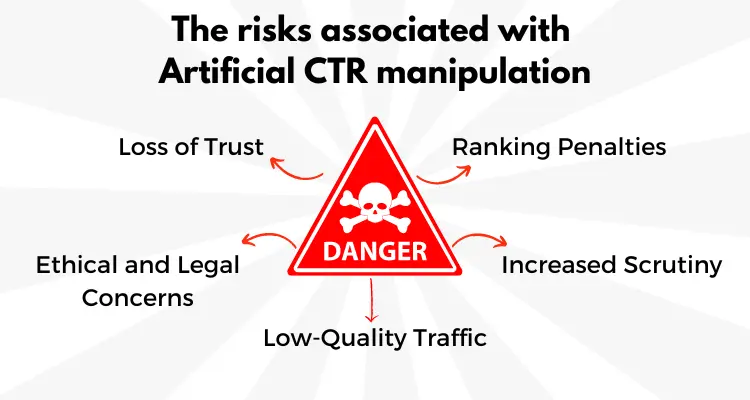
While the lure of quick SEO gains is strong, CTR manipulation comes with significant risks and downsides. Here are the key dangers and why most experts warn against this practice:
- Google Detection & Penalties: Google’s algorithms are continuously improving at detecting unnatural click patterns. If you flood Google with automated or coordinated queries and clicks, there’s a good chance Google will recognize the pattern as fake. When that happens, the consequences can be severe. In mild cases, Google simply ignores the inflated clicks, nullifying any ranking benefit. In harsher outcomes, sites have seen their rankings plummet overnight once Google’s systems (or a manual reviewer) identified manipulation. The worst-case scenario is a manual penalty or deindexing – Google could remove your site from results entirely if they determine you engaged in systematic search spam. Essentially, you risk all your SEO progress for a short-term trick. As one SEO commentator noted, “Google’s algorithms are far too sophisticated to be fooled by search bots for long”, and when caught, “the penalties can be devastating”. Losing Google’s trust means a long, difficult road to recovery. This risk alone makes CTR manipulation not worth it in the long run for most legitimate businesses.
- Short-Lived Gains (Ephemeral Effect): Even when CTR manipulation seems to work, the benefit is often fleeting. Google might temporarily boost a result that’s getting a spike in clicks (especially for trending topics), but it usually calibrates quickly. If the surge isn’t backed by sustained genuine interest, the algorithm can drop the page back down once the anomaly is detected or the “freshness” passes. In practice, some SEO experiments saw a ranking boost lasting only days or weeks. If you stop the artificial clicking, your CTR advantage disappears and so may the rankings. This creates a treadmill effect – you’d have to keep running the fake clicks continuously, which is costly and increases the chance of being caught. In essence, CTR manipulation is not a durable strategy; it’s a sugar rush, not a steady diet.
- Low-Quality Traffic (No Conversions): The clicks generated via manipulation are not real prospective customers. Bots don’t buy products or sign up for newsletters. Even human microworkers who click your site are usually not truly interested in your content; they’re doing a paid task. So while your Google Analytics might show a jump in sessions, these visits typically have zero value in terms of engagement or conversion. In fact, if you accidentally count them in your business metrics, they could mislead you about site performance. The ultimate goal of SEO is to attract relevant, high-intent visitors; CTR manipulation gives you the opposite – irrelevant visits just for show.
- Skewed User Behavior Signals: Fake clicks can mess with your user engagement metrics in unintended ways. Suppose your content isn’t actually satisfying for the query you’re forcing clicks on. Real users who arrive might bounce quickly, or the hired clickers might close the tab as soon as their job is done. This could result in high bounce rates or short dwell times overall, which in turn are negative signals to Google. Essentially, you might boost one metric (CTR) but harm others (time on page, pogo-sticking). Google looks at the whole picture of user behavior. As one source points out, “Search engines don’t just look at how many people click – they analyze what those people do once they arrive”. If your page gets clicks but users consistently leave quickly, Google will interpret that as the page not meeting expectations, which can offset any positive effect of CTR.
- Cost and Resource Wastage: Engaging in CTR manipulation can be expensive and time-consuming. High-quality bot services or crowdsourced clicks cost money – sometimes hundreds or thousands of dollars for large campaigns. Setting up your own system requires technical know-how and infrastructure (proxies, servers). If Google is indeed ignoring or fighting these signals, that money and effort yield no real ROI. Those resources could have been invested in legitimate SEO improvements (better content, link building, site speed, etc.) that provide real long-term value. For businesses operating on limited marketing budgets, the opportunity cost of chasing CTR hacks is significant. Essentially, it’s a gamble that might not pay off, leaving you with a lighter wallet and no lasting results.
- Violation of Google Guidelines (Ethical & Legal Issues): From a policy standpoint, CTR manipulation is outright search spam. It falls in the same camp as buying links or cloaking – intentional deceit to manipulate rankings. This means if Google catches on, you could face manual action. Also, engaging with shady click-farm services could expose you to scams or poor-quality traffic that triggers Google’s anti-spam algorithms. There’s also a minor legal concern: using bots to send automated queries violates Google’s Terms of Service. While Google isn’t likely to take legal action against a small website for this, it underscores how such practices are against the rules you agreed to. For agencies and professionals, getting a client penalized due to CTR manipulation could be disastrous for reputation and possibly client contracts.
- False Positives and Collateral Damage: Interestingly, even if you don’t do CTR manipulation, a competitor could maliciously send fake clicks to your site (hoping Google will think you’re doing it). Google says they generally ignore such attempts to harm others, but there’s always a risk of false positives. If you do it yourself, you might inadvertently cause patterns that trigger anti-spam systems affecting your site’s trust. In SEO, trust and credibility with search engines are hard to earn and easy to lose.
In summary, the long-term risks far outweigh the short-term gains when it comes to CTR manipulation. Google is strongly incentivized to ensure that actual relevance and quality determine rankings, not easily-faked metrics like raw click count. They’ve been aware of click spam attempts for well over a decade and have adapted accordingly. Any short-term win from gaming CTR is built on shaky ground. Most SEO experts conclude that it’s better to focus on genuine improvements that boost real CTR (and user satisfaction) rather than resorting to artificial manipulation.
Google’s Stance on CTR Manipulation
Google’s public stance on CTR manipulation – and user interaction signals in general – has been firm and somewhat dismissive. Officially, Google downplays the role of CTR in rankings and discourages any attempts to manipulate it. Key points from Google and its representatives include:
- CTR is Not a Direct Ranking Factor: Google engineers and spokespeople have stated multiple times that they do not use CTR as a direct signal in their core ranking algorithm. The rationale is that CTR data is too easily spammed and not consistently reliable across all searches. For instance, at Pubcon 2016, Google’s Gary Illyes said “clicks in general are incredibly noisy… people do weird things on search results… it’s really, really hard to clean up that data”. Similarly, in a Reddit Q&A, Google’s John Mueller commented that these metrics are “way too noisy for search in general” and not used to rank results for broad algorithmic purposes. Google has acknowledged they did experiment with using click data in the past and use it internally for testing (e.g., to evaluate search quality in A/B tests), but they insist it’s not part of the live ranking formula for users because of the manipulation risk.
- Mass Clicks Don’t Help (and Won’t Hurt) Rankings: When asked directly about scenarios like hiring an army of people to click on your site, John Mueller responded that it “does not hurt or help” your rankings. In August 2022, he reiterated that Google doesn’t use click data for ranking, aside from possibly personalizing results for a single user. He also indicated Google doesn’t apply a penalty just for lots of clicks – rather, they algorithmically discount it so it has no effect. In short, Google’s stance is that they neutralize click manipulation such that it neither benefits nor damages the target site’s ranking. (Of course, if the behavior is extreme, it could lead to a spam investigation, but Google’s ideal solution is to ignore the signal.)
- Automated Queries Violate Policy: Google’s Webmaster Guidelines (Search Essentials) explicitly call out machine-generated traffic – which includes automated search queries – as a violation of spam policies. Automated rank checking or querying is discouraged because it consumes resources and can degrade search quality. By extension, automated CTR manipulation is against the rules. Google’s Terms of Service also forbid sending automated queries without permission. So while Google might not have a specific “CTR manipulation penalty” name, any site benefiting from large-scale automated clicks is treading in forbidden territory and could be subject to manual action if discovered.
- Quality vs. Quantity of Clicks: Leaked insights and patents suggest Google cares about click quality more than sheer volume. A recently discussed concept (from internal leak nicknamed “Navboost”) indicated Google “tracks quality clicks” – essentially looking at patterns of user navigation over time to gauge if a page is truly valuable. If a page gets a burst of clicks but those visitors don’t engage or the pattern looks artificial, Google can deem those clicks low-quality and ignore them. This aligns with Google’s general approach: they try to measure long-term user satisfaction, not momentary spikes. So, fake clicks might register initially but won’t pass the quality filter in the long run.
- Emphasis on Genuine Engagement: Google often advises webmasters to improve actual user experience and engagement (which can naturally improve CTR and other metrics) rather than chasing algorithm exploits. The message is clear: focus on making your pages something users want to click and enjoy, and you won’t have to worry about gimmicks. Any form of manipulation is ultimately a losing game, as Google’s algorithms and manual review processes will catch up eventually. Indeed, Google’s documentation and spokespeople encourage optimizing titles and descriptions to improve CTR in a legitimate way – because that’s about appealing to users – but strongly frown upon artificial boosting.
In summary, Google’s stance can be summed up as: “Don’t waste your time trying to game CTR. We don’t count it the way you think, and if you push it, we’ll just ignore or penalize it.” As one Search Engine Journal article concluded, “there’s no point trying to game this one – Google was onto it decades ago.”. For SEO professionals, taking Google at their word means investing effort in real user-centric improvements rather than risky schemes.
Ethical Considerations in CTR Manipulation
Beyond the practical risks, CTR manipulation raises ethical questions in the SEO and marketing realm. SEO is often about finding creative ways to improve rankings, but there’s a line between clever optimization and outright deception. Here are some ethical angles to consider:
- Misleading the Search Engine: CTR manipulation is essentially lying to Google’s algorithm about what users find valuable. It’s akin to stuffing keywords or buying links – you’re sending a false signal of relevance. Ethically, this conflicts with the principle of maintaining a fair and relevant search ecosystem. Google’s aim is to rank content that genuinely satisfies users; by injecting fake engagement, you’re trying to subvert that process. This not only risks a penalty, but it’s unfair to the websites that are following the rules and focusing on real user satisfaction. In the long run, if many attempted to manipulate CTR, it could reduce the quality of search results for everyone (imagine searching Google and getting results that ranked due to bot clicks, not because they’re the best content).
- Misleading Users and Clients: If CTR manipulation “succeeds” in boosting your ranking, you might be attracting clicks from real users under false pretenses. Users click because they think your result is popular or the best answer, but if it’s artificially placed higher than it deserves, they could be disappointed by the content. As the Stan Ventures blog noted, “when users click expecting one thing but get something else, you’ve failed them and damaged your reputation”. Trust is hard to win back once a user feels misled. Moreover, within organizations, pushing black-hat tactics can lead to ethical dilemmas. Stakeholders or clients might not be fully aware of how you’re achieving results. If things go south (like a penalty), you’ll have to explain that you took a risky shortcut. For agencies, this can be especially damaging – it’s your reputation on the line. Ethically, transparency with clients and focusing on sustainable practices is the better path.
- “Ends Justify the Means” Mentality: Relying on CTR manipulation fosters a mindset of chasing shortcuts over substance. It might start with clicking bots, but that can bleed into other grey/black-hat areas. SEO professionals often debate ethics; many adhere to a code of not doing harm and not deceiving for rankings. Once you cross that line, it becomes easier to justify other manipulations (fake reviews, cloaking content, etc.). This slippery slope can erode the overall integrity of your marketing strategy. White-hat SEO, on the other hand, emphasizes user-first changes that build long-term equity – better content, helpful user experiences, legitimate promotion. Ethically, most would argue that delivering real value should be the focus, not gaming metrics.
- Impact on Low-Quality Content: Ethically, do you deserve to rank higher if the only thing you improved was your CTR number artificially? If a page isn’t earning clicks on its own, maybe the title or content needs improvement. Manipulation might prop up a low-quality page above better ones, which is a disservice to searchers. From an ethical SEO perspective, boosting a page’s ranking should come from making that page better, not from tricking the system. The best practice is to earn clicks by being relevant – for example, by rewriting your title tag to be more appealing (that’s ethical) rather than sending bots (unethical).
- Exploitation of Workers: In cases of crowdsourced clicks or click farms, there’s an ethical consideration regarding the workers. Often these tasks pay very little, and workers are essentially asked to contribute to a deceptive practice. One could argue it’s not terribly different from any micro-job, but it’s worth noting that you’re involving real people in a scheme that has no value to them or the end-users of Google. There’s a minor but real ethical question about using human labor for fraudulent engagement – though among all concerns, this might be lower on the list.
Ultimately, the ethical approach to SEO is encapsulated well by the idea that SEO should be about creating value and improving websites for users, not cheating algorithms. CTR manipulation clearly falls on the wrong side of that line. Many SEO professionals and reputable agencies avoid such tactics to maintain integrity and trust. It’s always wise to ask: “If this tactic were fully transparent to users and search engines, would I still do it?” For CTR manipulation, the answer would be no – because it only works under secrecy and deception. That alone is a strong indicator it’s not ethically sound.
Case Studies and Real-World Examples
CTR manipulation isn’t just a theoretical concept; there have been several real-world experiments and incidents that shed light on its effects:
- Rand Fishkin’s CTR Experiment (2014): One of the most cited examples is by SEO expert Rand Fishkin. He published a blog post and then publicly asked his Twitter followers to Google a certain phrase and click his result. The result? Within hours, his blog post jumped to #1 in Google for that targeted query (from nowhere) and got a few hundred visits. This was a short-term test on a low-competition query, but it demonstrated that a sudden influx of clicks could influence Google’s rankings in the very short term. Fishkin was careful to note this wasn’t proof of a broad ranking factor, but it opened many eyes to the possibility that Google’s algorithm might react to unusual click patterns (perhaps as part of detecting trending topics). The page did not stay at #1 for long, and Google later implied this was likely part of a temporal boost rather than a lasting ranking change. Nonetheless, this experiment is often referenced as evidence that CTR manipulation can work in bursts, and it arguably kicked off a wave of SEOs trying their own “crowd click” stunts.
- TechJackie’s Case Studies (2021 & 2024): SEO blogger Jackie Owen (TechJackie) reported two case studies using CTR manipulation. In the first, a mature site stuck on page 2-4 saw dramatic improvement after he started a CTR campaign in mid-2021. According to the case study, the site moved from rank 34 to rank 10 in 22 days with nothing else changed except the introduction of clicks. It even climbed to rank 3 at best, and months later was still on page 1. They stopped the CTR efforts after reaching the top 10 due to resources, yet the ranking held fairly well (slowly dropping to around #9-10 many months later). This suggests that if the page had inherent quality, the initial boost helped it gain real exposure and perhaps real engagement, anchoring it on page 1. The second case in 2024 involved a brand new site. After launch, they waited 10 days then started CTR manipulation focusing on the brand name keyword. In 14 days, they saw a big jump in rankings for the main keyword. They delivered 93 clicks over those 2 weeks, and this not only boosted the primary keyword but improved the whole set of keywords for that page. These case studies indicate that CTR manipulation, when done with “real humans from fresh, real IPs” (as the author emphasizes) can yield tangible ranking improvements. However, the author also cautioned that using easily traceable sources like common micro-job networks might only give a temporary boost that “won’t last”, implying Google filters out known patterns.
- Instances of No Effect or Penalty: For balance, there are also accounts where CTR manipulation didn’t work or backfired. An SEO review on FatRank tested the SearchSEO bot tool extensively and reported “we did not see the benefits we expected” – essentially, the fake clicks did not improve rankings in their tests. This aligns with reports from others that Google might be discounting those signals. Additionally, the Stan Ventures article from 2025 mentions seeing sites that rode a “CTR high” briefly then crashed, struggling to recover afterwards. In one example, a site’s rankings plummeted the day after the manipulative CTR wave ended, presumably due to Google’s detection or the withdrawal of the artificial support. There are also cases of sites on SEO forums claiming they got a manual action for “user traffic manipulation” – though Google doesn’t publicly confirm these. It’s anecdotal, but it underscores the risk of being the unlucky one caught in a crackdown.
- Google’s Rapid Click Adjustment (Navboost Leak): SparkToro (Rand Fishkin’s company) reported on leaked Google documents around an algorithm called Navboost (Navigational Boost). While not officially confirmed by Google publicly, the leak suggested that Google tracks how users interact with a site over time – not just the immediate click, but whether they come back to it, navigate within it, etc. If a site gets a burst of new clicks but those don’t turn into longer-term engagement, Navboost would stop boosting that site. This aligns with experiences where CTR manipulation only yields short-term ranking changes. So, the case could be made that Google has mechanisms to use CTR-like data for very brief ranking adjustments (to test if a result might be good), but then it requires quality persistence (users continuing to engage) to keep that ranking. Artificial clicks won’t provide that sustained engagement, so the boost is an illusion. This internal insight reinforces why purely gaming CTR is unreliable.
- Competitor Sabotage Anecdote: Some SEO professionals have whispered about using CTR manipulation against competitors. For instance, hiring a click farm to click a competitor’s result and then bounce immediately repeatedly, hoping to send negative engagement signals (low dwell time, high bounce). Google’s John Mueller has said doing this won’t hurt the competitor (because again, Google supposedly doesn’t let that stuff impact rankings). There’s no concrete public case study of a competitor being penalized or dropping solely due to such sabotage – likely because Google indeed filters it out. Still, it’s part of the lore of CTR manipulation in the real world; it’s a tactic some have attempted, though not necessarily with success.
Key Takeaway from examples: CTR manipulation can sometimes produce short-lived ranking improvements, especially if done in a clever, moderate way. However, these examples also show that maintaining those gains is difficult without genuine user satisfaction to back it up. Many SEO veterans who experimented with this “dark side” tactic ended up concluding that it’s “an illusion of success” – the wins fade quickly and the risks (drops or penalties) loom large. Real-world usage of CTR manipulation remains mostly in the shadows (shared in closed SEO circles) because those who find a working formula tend not to publicize it, and those who fail often warn others not to try.
Conclusion: Balancing CTR and Long-Term SEO Strategy

Click-through rate is undoubtedly an important metric in SEO – but how you improve it makes all the difference. While CTR manipulation offers a tempting shortcut to boost organic CTR and possibly nudge rankings, it comes with heavy baggage of risk, uncertainty, and ethical compromise. As we’ve explored, artificially gaming user signals like CTR might bring momentary gains, but it’s not a sustainable or recommended SEO strategy. Google’s stance and the weight of evidence suggest that any ranking signal boost from fake clicks is at best temporary and at worst harmful to your site’s standing.
For SEO professionals and marketers, the smarter approach is to channel that energy into legitimate ways of improving CTR and user engagement:
- Optimize Title Tags and Meta Descriptions: Craft compelling, relevant titles and descriptions that make searchers want to click (without being clickbait). This naturally increases your organic CTR by appealing to real users, thus boosting traffic ethically. It’s essentially free CTR improvement – and unlike fake clicks, these are real interested visitors. Google rewards content that aligns with user intent, so delivering on the promise of your snippets will keep those users engaged.
- Structured Data and Rich Snippets: Implement schema markup to enable rich results (star ratings, FAQs, etc.) which can draw the eye and improve CTR. These techniques enhance your snippet’s visibility legitimately and often lead to higher click-through because your result provides more info or visual appeal. Again, this is boosting CTR by adding value for the user in the SERP.
- Content Quality and Relevance: Ultimately, nothing beats having the best answer to the query. If your content is high-quality, up-to-date, and matches search intent, users are more likely to click it and stay on it. This will organically improve both your CTR and post-click engagement metrics. Satisfied users may share your content or link to it, creating a virtuous cycle of SEO benefits that no bot network can replicate.
- Improve User Experience: A fast, mobile-friendly site with intuitive navigation helps ensure that when users do click through, they have a good experience (which means they won’t bounce and might convert). Google’s algorithms increasingly factor in page experience. By focusing on UX (page speed, mobile design, clear layout), you increase the chances that users choose your result (because maybe your brand has a reputation for good UX) and that they engage positively once they land. Over time, good UX contributes to better SEO performance in general.
- Build Brand and Trust (for Higher CTR): Users are more likely to click results from sources they recognize or trust. Investing in brand building (through content marketing, social media, PR) can indirectly lift your CTR because searchers see your name and feel confident clicking it. This is a long-term play, but it’s exactly how you future-proof your SEO – by being the result people want to click, not by forcing them.
In the end, CTR manipulation is a high-risk gamble. It might seem like a clever hack in the short term, but it fails to build any real value. The consensus among experienced SEO practitioners and even the offered evidence from Google is to avoid such black-hat tactics. Instead, focus on earning your clicks through relevant content and genuine engagement. Not only will this approach keep you safe from penalties, but it will also ensure that the traffic you gain is meaningful and likely to convert.
Remember, SEO is a marathon, not a sprint. Chasing algorithmic loopholes like CTR manipulation can distract from the real goal: making your site the best result for your target queries. By prioritizing accuracy, usefulness, and user-centric optimization, you’ll naturally improve your click-through rates the right way – and enjoy rankings that last. As one SEO commentary succinctly put it, CTR manipulation is a shortcut that leads nowhere. The real path to SEO success is to boost your organic CTR by being genuinely the result that searchers want to click, not by trying to fool them or the search engine.


